
Why Designing Extended Sizes Isn’t “Too Hard”—It’s Just Underfunded
One of the most common explanations brands give for stopping at size 24 is that extended sizes are “too difficult” to design and produce. You’ve likely heard it framed as a technical limitation, a logistical headache, or an unfortunate but unavoidable reality of fashion.
But here’s the truth: “difficult” is not the same as impossible.
Complexity has never stopped innovation in fashion before—so why is it used as a stopping point when it comes to dressing larger bodies?
Designing Extended Sizes Is Different—But That’s Not a Flaw
It’s true that bodies in larger sizes vary more widely in proportion. Weight distribution changes. Torso lengths differ. Curves appear—and shift—in ways that straight-size patterns simply don’t account for.
Fit needs in extended sizes are more nuanced. One-size-fits-all grading approaches don’t work, and pretending they do is where many brands go wrong.
Designing well for extended sizes requires:
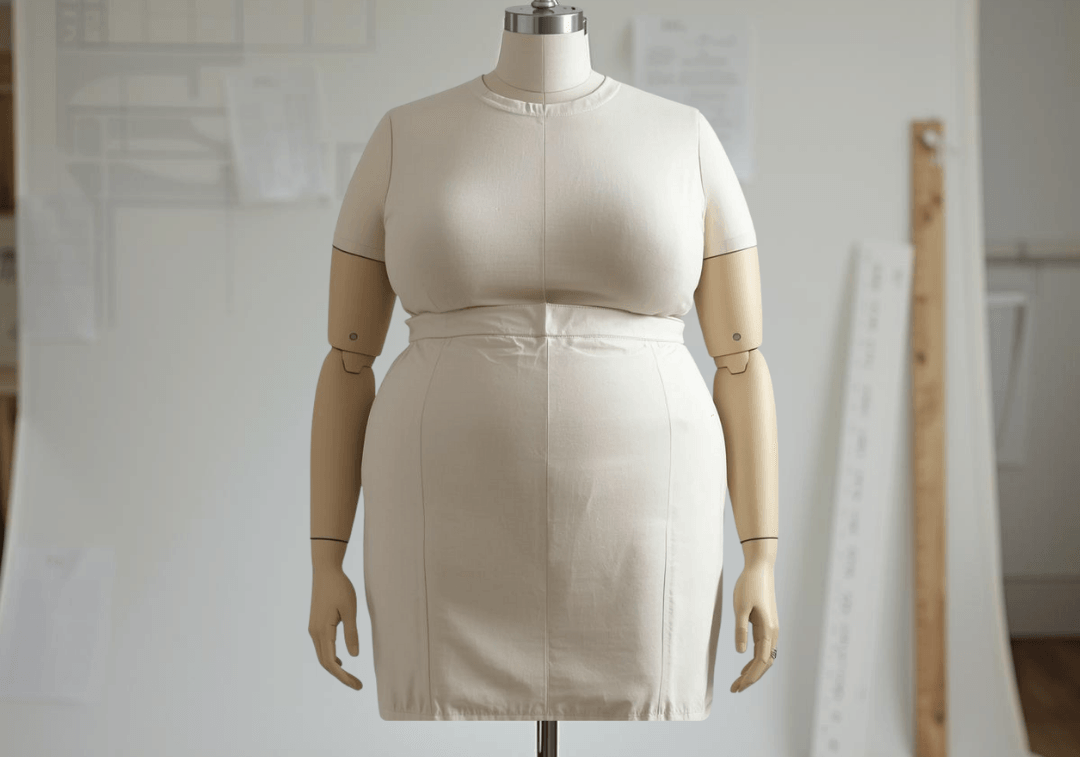
Skilled, intentional patternmaking
Multiple fit models across sizes
Thoughtful testing and iteration
Time, attention, and experience
Yes, that’s more work. But none of it is a dead end. These are design challenges to be solved—not excuses to stop making clothes for real bodies.
The Real Barrier Isn’t Difficulty—It’s Infrastructure
The biggest issue isn’t that extended sizes are inherently harder to design. It’s that most fashion systems were never built to support them.
For decades:
Design education has centered almost exclusively on straight-size bodies
Many designers graduate without training in extended-size fit
Production facilities are optimized for smaller sizes
Machinery, cutting tables, and workflows are scaled accordingly
Factories that can handle extended sizing do exist—but working with them requires intention, investment, and a willingness to do things differently. And that’s where many brands hesitate.
Size 24 Isn’t a Technical Limit—It’s a Business Choice
When brands choose not to invest in inclusive patternmaking or seek out capable production partners, size 24 becomes the default ceiling.
Not because bodies above it are impossible to dress—but because expanding requires resources, time, and the courage to challenge long-standing habits.
Designing extended sizes isn’t a question of talent.
It’s a question of priority.
Brands That Commit Prove It Works
The good news? Brands that commit to extended sizing from the start prove—every single day—that it works.
Retailers who treat fit as foundational rather than optional show that extended sizes aren’t an obstacle. They’re simply part of the standard.
When brands:
Allocate proper resources
Hire fit models in every size
Test garments thoroughly and thoughtfully
Designing for size 26, 28, 30, and beyond becomes just another step in the process—not a headache to avoid.
Extended Sizing Is an Opportunity, Not a Limitation
Inclusive brands demonstrate what the rest of the industry often refuses to acknowledge: extended sizing isn’t a limitation—it’s an opportunity.
An opportunity to:
Meet customers where they actually are
Respect and celebrate real bodies
Build trust and long-term loyalty with shoppers who have been ignored for decades
Designing for extended sizes isn’t “too hard.”
It’s underfunded.
And until the fashion industry invests in the people, processes, and knowledge required to make extended sizing standard—not exceptional—the myth of “too hard” will continue to hold back innovation that’s long overdue.

SHOP OUR AMAZON STOREFRONT
Discover our handpicked collection of products for plus-size
living-from cycling gear and adaptive equipment to clothing,
travel essentials, home must-haves, and more.
*As an Amazon Associate, we may earn from qualifying purchases.*


© 2025 by Body Ready LLC. All rights reserved.
We are a participant in various affiliate programs—including Amazon Services LLC Associates Program, Walmart Affiliate Program, Impact.com, CJ.com, Awin, and other brand affiliate programs—designed to provide a means for us to earn commissions by linking to their affiliated sites.


